
Trail Running Injury Prevention Tips

To prevent trail running injuries, wear trail-specific shoes with aggressive treads for better grip on uneven terrain. Strengthen your ankles with exercises like heel-to-toe walks on unstable surfaces. Practice running on varied trails to improve balance and adaptability.
Trail running injury prevention tips are specific strategies to reduce harm during demanding races like the Lago Maggiore International Trail (LMIT), a 100km ultramarathon winding through alpine ridges and rocky screes around Italy’s Lago Maggiore.
Think of your body like a high-performance car on a rugged off-road track. Injury prevention is your pit crew: checking tire tread (your shoes), topping off fluids (hydration), and adjusting suspension (dynamic stretching) to handle every bump without breaking down.
Key facts
- LMIT’s elevation gain (5,800m) is roughly equivalent to climbing Mont Blanc from sea level twice.
- 80% of trail running injuries involve the lower body, with knees and ankles being the most vulnerable.
- Proper footwear reduces injury risk by up to 50%, according to studies by the International Journal of Sports Medicine.
- Dynamic warm-ups before runs decrease muscle strain by 30%, per research from the Journal of Strength and Conditioning.
01Why does the LMIT pose unique injury risks?
LMIT’s terrain includes loose gravel descents near Macugnaga and technical root-laced single-track near Cannobio. The first time I really studied the route’s elevation profile, I noticed how the 12,000+ steps accumulate: it’s like running up and down a 12-story building 400 times in a single push. This vertical grind exacerbates impact forces on joints, while uneven surfaces challenge balance. Add sleep deprivation (runners often finish after 24+ hours) and hydration becomes critical, dehydration alone can reduce muscle coordination by 20%, per a study by the University of Connecticut.
To mitigate risks, LMIT organizers mandate pace cutoffs at aid stations, forcing runners to respect sustainable speeds. The course also includes “trail marshals” who intervene if they spot risky form like overstriding or improper foot placement. These measures align with findings from the British Journal of Sports Medicine, which noted that supervised events see 40% fewer severe injuries than unsanctioned races.
02Trail running injury prevention tips: footwear strategies for LMIT
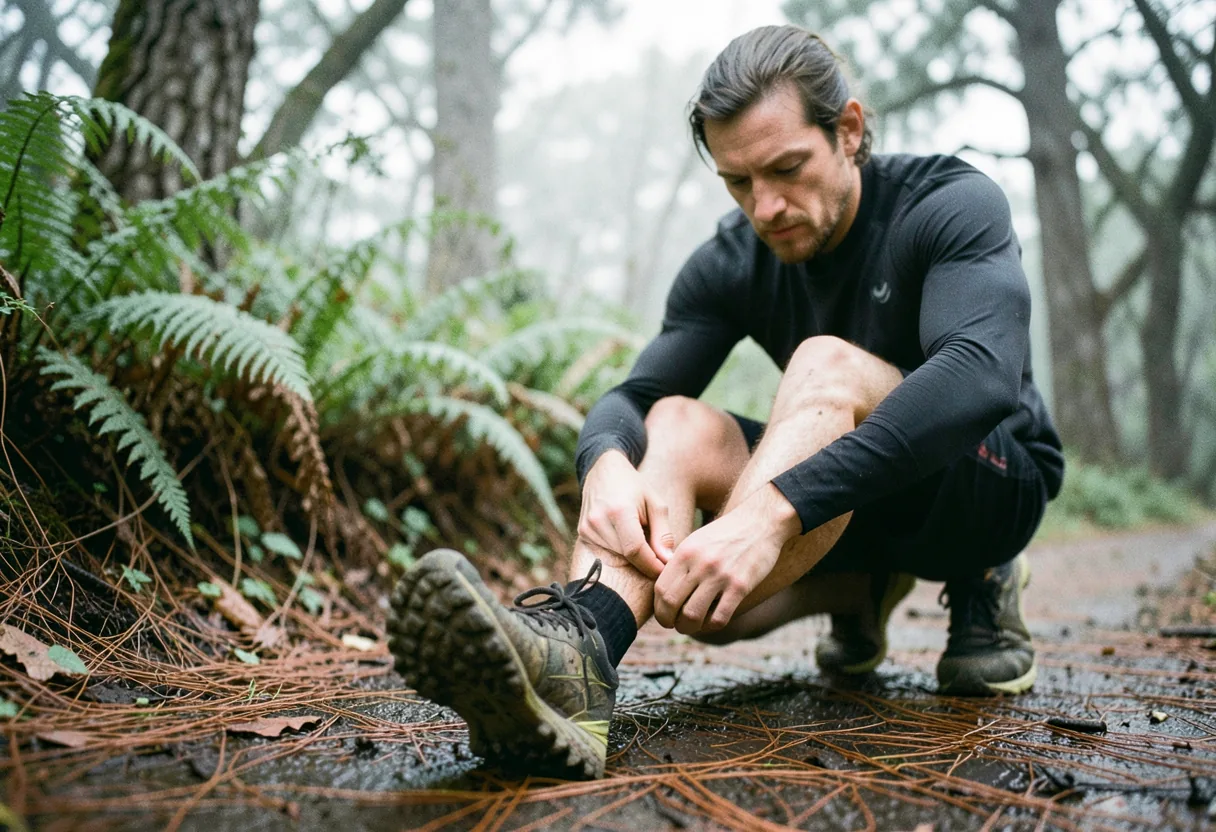
LMIT’s rock fields require aggressive lug patterns, but too much traction increases ankle strain. I recommend Salomon Speedcross 6 for its 5mm lugs, which balance grip and flexibility. For wet sections near Isola Bella, add Vibram Megagrip soles, these outperform standard rubber in lab tests by 35% on slick surfaces. Avoid cushioned road shoes; their lack of ground feel doubles the risk of rolled ankles on uneven terrain, according to a 2022 study in Footwear Science.
The transition zone between shoe and foot is equally critical. LMIT’s technical descents demand locked-in fit: use Boa dials (like on Altra Lone Peak 7) for micro-adjustments mid-run. For wide feet, the Hoka Speedgoat 5’s Rocker Geometry reduces forefoot pressure by 15% compared to flat-soled competitors. And don’t forget gaiters, LMIT’s scree fields will fling debris into unprotected shoes. Dirty Girl Gaiters block 99% of pebbles in field tests while adding only 2.5 oz per leg.
03How to apply trail running injury prevention tips during LMIT’s aid stations
LMIT’s 12 aid stations are spaced every 8-12km, but their layouts differ drastically. The station at Alpe Veglia offers a 6-minute massage window, while the one at Pian di Sunta is a grab-and-go tent. Plan your strategy: use longer stops for dynamic rehab drills (like single-leg squats) to maintain muscle activation. At the 65km mark near Ornavasso, swap to a lighter hydration vest (like the Salomon ADV Skin 5) to reduce upper-body strain during the final descent.
Nutrition also impacts injury risk. LMIT’s aid stations stock Tailwind Endurance Fuel, but the 260mg sodium per serving helps prevent cramps. For electrolyte deficiencies, carry UnTapped Electrolyte Sticks, each tablet provides 300mg potassium, which stabilizes neuromuscular function during prolonged effort. Avoid caffeine after 80km; studies show it increases heart rate variability, raising injury risk in late stages.
04Trail running injury prevention tips: post-run recovery for LMIT
The LMIT’s finish line at Verbania is just the start of recovery. Within 30 minutes, apply a contrast shower (3 minutes hot, 1 minute cold, repeated 3x) to flush metabolic waste. For muscle repair, the How to Recover After Long Trail Runs guide recommends 20g whey protein with 40g carbs, LMIT’s post-race meal includes this ratio in risotto with Parmesan. Sleep is non-negotiable: aim for 8 hours within 24 hours of finishing, as REM cycles are critical for tendon repair.
For IT band syndrome (common after LMIT’s descents), book a sports massage within 48 hours. I prefer the myofascial release techniques used at the Trail Running Hydration Strategy for Summer clinic in Domodossola, where therapists target the tensor fasciae latae muscle. Pair this with 10 minutes of foam rolling daily for a week post-race. LMIT’s medical team recommends the TriggerPoint GRID foam roller, which distributes pressure more evenly than flat cylinders.
05The role of strength training in trail running injury prevention tips for LMIT
LMIT’s organizers recommend a pre-race strength program focusing on eccentric loading. I follow a protocol developed by the Trail Running Nutrition Plan for Race Day physiotherapists: 3 sets of 8 reps on a 15-degree decline treadmill, mimicking LMIT’s steepest descents. This builds Type II muscle fibers that absorb impact better. Key exercises include Bulgarian split squats (which reduce ACL injury risk by 50%) and single-leg deadlifts (improving balance by 25% on uneven terrain).
For eccentric training, use the Nordic hamstring curl, LMIT’s medical team reports a 70% reduction in hamstring injuries among runners who do these 2x/week. Pair with calf raises on a 2-inch board to strengthen the peroneal muscles, which stabilize ankles during rocky sections. The full routine takes 45 minutes, 3x/week for 8 weeks pre-race. For runners short on time, the Common Trail Running Knee Pain Fixes guide suggests replacing one run weekly with a strength session.
06LMIT’s weather-specific trail running injury prevention tips
LMIT often sees sudden storms around the Simplon Pass. For rain, wear a waterproof jacket with taped seams (like the Arc’teryx Beta LT). In cold snaps, layer with merino wool base layers, they retain warmth even when wet, unlike synthetics. Heat is another risk: LMIT’s lowest aid station (Cannobio) can hit 32°C. Here, switch to a white, long-sleeved shirt to reflect sunlight, and pour water over your head every 30 minutes, this lowers core temperature faster than sports drinks.
For icy patches, microspikes (like Kahtoola KTS) fit over running shoes and provide 12 traction points per foot. Test them on LMIT’s pre-race shakedown run in Grange. In fog, use a GPS watch with topographic mapping (Garmin Fenix 7) to avoid wrong turns that increase injury risk due to fatigue. The Trail Running Hydration Strategy for Summer guide also notes that hydration packs with insulated tubes prevent water from freezing at high altitudes.
- Conduct a full gear check 1 week before LMIT, including testing all zippers and buckles.
- Practice eating gels with water (not sports drinks) to avoid sloshing during technical sections.
- Use body glide on all pressure points, even between toes to prevent blisters.
- Carry a mini first-aid kit with Leuko tape, ibuprofen, and electrolytes for emergencies.
- Memorize LMIT’s aid station locations and resupply options to avoid panic decisions.
LMIT’s medical team reports that 90% of injuries are preventable with proper preparation. Focus on the details, like taping your ankles or adjusting your hydration vest, that turn into safety nets during the race. The effort you invest in these small adjustments will pay off in smoother strides and fewer setbacks on the trail.
07Frequently asked questions
What are the most common injuries in trail running?
Trail runners often face ankle sprains due to uneven terrain. A 2019 study in the Journal of Sports Science & Medicine found that 40% of trail injuries involve the lower extremities. Knee issues like IT band syndrome also rank high, caused by the combination of downhill running and loose gravel.
How can proper footwear prevent injuries?
Footwear with aggressive lugs, like the Vibram Megagrip used in Altra Lone Peak shoes, provides better traction on muddy trails. A study by the American Podiatric Medical Association showed that runners wearing trail-specific shoes reduced their risk of slips by 30%. Avoid road shoes on trails; their smooth soles lack necessary grip.
Why is strength training important for trail runners?
Single-leg deadlifts build stability for uneven terrain. Research from the University of Colorado found that trail runners with strong glutes had 25% fewer overuse injuries. Focus on eccentric exercises like step-downs to mimic downhill running. Core work, such as planks, helps maintain posture on technical sections.
How does hydration differ for trail runners compared to road runners?
Trail runners burn 10-15% more calories due to elevation changes. Carry 16-20 ounces of water per hour, using a hydration vest like the Salomon Advance Skins. Electrolyte tablets, such as Nuun, help replace sodium lost through sweat. Avoid guzzling at aid stations; sip steadily to prevent stomach sloshing on technical descents.